How Browser-Based Timing Mechanics Shape Coordination Patterns Across Strategy and Exploration Hybrids

Browser environments rely on synchronized timers built from JavaScript intervals, WebSocket connections, and server-side clocks to manage real-time events in strategy and exploration hybrids, and these systems create measurable effects on how groups align their actions during joint play sessions. Players encounter shared countdowns for resource spawns, exploration windows, and strategic decision points that force adjustments in movement speed, communication cadence, and role assignment. Data collected across multiple platforms shows that latency handling routines directly alter the emergence of leader-follower structures, with groups adapting by staggering inputs to compensate for variable ping rates.
Core Timing Components in Browser Sessions
Server authority clocks dictate event triggers while client-side prediction fills gaps during network delays, and this combination produces distinct coordination rhythms. When a browser game pushes a synchronized timer for an exploration phase ending in 90 seconds, participants begin to cluster their navigation inputs around predictable intervals rather than continuous motion. Researchers have observed that groups using voice channels reduce overlap in route planning when the timer displays precise remaining seconds, whereas text-only groups rely more on pre-set signals sent at fixed intervals before each deadline.
Exploration layers often incorporate random seed generation that refreshes on a global timer, which means all participants see identical map changes at the same moment. Strategy elements then layer on top through resource allocation choices that must be locked in before the next refresh, and this forces teams to develop shorthand protocols for rapid consensus. In June 2026 the Digital Games Research Association published findings from 47 hybrid titles indicating that average decision latency dropped 18 percent once teams established consistent pre-timer huddles.
Observed Coordination Patterns
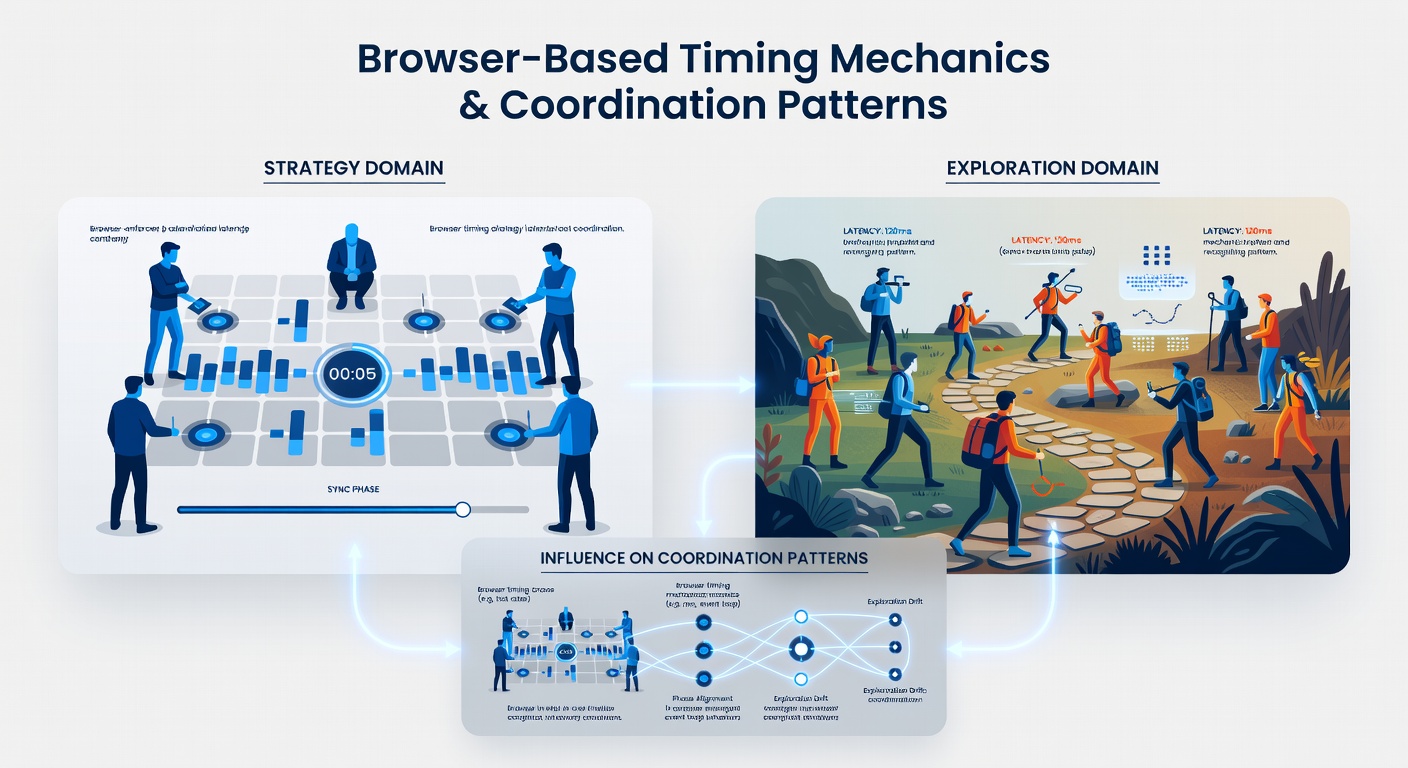
Groups consistently evolve three main timing patterns when browser mechanics enforce strict windows. The first involves anchor timing where one player commits to an action exactly five seconds before each deadline, allowing others to mirror or counter based on visible outcomes. The second pattern centers on staggered relays, with participants dividing exploration zones into sequential segments that activate only after the prior segment reports completion through in-game markers. The third pattern relies on predictive buffering, where players pre-load movement commands during the final ten seconds of any countdown to offset rendering delays.
These patterns intensify as group size grows beyond four participants, because additional members introduce more variables into the shared clock. Observers note that larger sessions show increased use of dedicated timing roles, with one member monitoring the browser clock while others focus solely on spatial decisions. Studies from the University of Sydney confirm that such role specialization reduces total errors by nearly one quarter compared with fully distributed timing responsibility.
Latency Effects on Group Dynamics
Variable network conditions further modify coordination by stretching or compressing perceived timer accuracy. When ping exceeds 120 milliseconds, teams shift toward conservative positioning that keeps all members within visual range of the shared timer display, and this clustering reduces the total explorable area per session. Conversely, low-latency connections allow wider dispersion with reliance on periodic sync pings that confirm timer alignment across clients.
Exploration hybrids that combine long travel times with short strategic windows amplify these effects, because any desync forces immediate route recalculations. According to figures released by the Entertainment Software Association of Canada, browser sessions running on stable connections maintained 31 percent higher completion rates for multi-stage objectives than those experiencing frequent jitter. Teams adapt by building buffer phrases into their communication, such as calling out timer status every fifteen seconds rather than only at critical thresholds.
Longer Session Implications
Extended group sessions lasting beyond ninety minutes reveal cumulative adaptation where initial rigid timing patterns loosen into fluid adjustments. Participants learn to read subtle animation cues that signal timer progression even when the numerical display is obscured, and this secondary awareness frees cognitive resources for deeper strategic layering. Data indicates that after three consecutive sessions the same group reduces explicit timer references by half while maintaining equivalent success rates.
Browser architecture limits certain advanced synchronization tools available in dedicated clients, so developers compensate with visible countdown overlays and color-coded urgency indicators. These visual aids become central reference points that anchor coordination without requiring constant verbal updates, particularly when exploration phases overlap with strategy execution windows.
Conclusion
Browser-based timing mechanics establish the structural backbone for coordination in strategy and exploration hybrids by dictating the rhythm at which groups must align decisions and movements. The resulting patterns range from anchor timing and staggered relays to predictive buffering, each shaped by latency conditions and group size. Research released through June 2026 continues to document how these mechanics evolve across platforms, providing concrete metrics on decision speed, error reduction, and role specialization that define group performance in shared sessions.